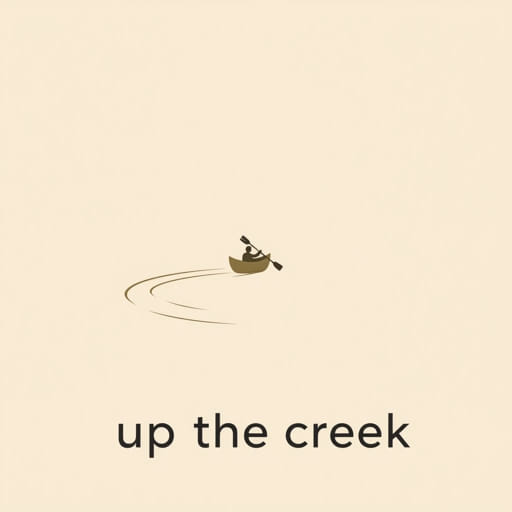
The idiom ‘up the creek’ is a colorful expression in English that is often used to describe a situation where someone is in trouble, facing difficulties, or in a challenging predicament without easy solutions. It conveys a sense of being stuck or trapped in an unfavorable circumstance. This phrase, rich in imagery and meaning, is widely used in everyday conversations, literature, and media to emphasize the urgency or severity of a problem. Understanding the meaning, origin, and use of ‘up the creek’ can enhance your grasp of English idioms and improve your communication skills.
What Does ‘Up the Creek’ Mean?
When someone says they are ‘up the creek,’ it means they are in a difficult or problematic situation. The phrase usually implies that the person lacks resources or options to easily escape the trouble they face. It often comes with an unspoken continuation: ‘without a paddle,’ highlighting helplessness or lack of control. For example, ‘If we miss the deadline, we’ll be up the creek without a paddle,’ means there will be serious consequences without any easy fix.
Common Uses of the Idiom
- Describing financial troubles: ‘After losing his job, he found himself up the creek.’
- Facing legal or disciplinary problems: ‘If the manager finds out, we’re up the creek.’
- Being in a difficult situation with no immediate solution: ‘Without the right tools, the repair is up the creek.’
Origin of the Idiom ‘Up the Creek’
The phrase ‘up the creek’ dates back to at least the 19th century, and its origins are believed to come from the imagery of being stuck in a small waterway called a creek. Imagine a person in a boat or canoe who has drifted into a narrow, shallow creek with no easy way to get back to open water. Without a paddle, they are helplessly stranded, unable to move freely. This vivid image of being trapped helped the phrase evolve into a metaphor for any troublesome situation.
The fuller version, ‘up the creek without a paddle,’ became popular later to emphasize the hopelessness of the scenario. Over time, the shorter form ‘up the creek’ gained popularity in informal speech, but the full phrase still appears in writing and speech to highlight severity.
Variations and Related Expressions
While ‘up the creek’ is the most common form, several variations and similar idioms convey comparable meanings. Understanding these helps enrich vocabulary and provides options for nuanced expression.
- Up the creek without a paddle: The complete phrase emphasizing helplessness.
- In hot water: Also means in trouble or facing difficulties.
- Between a rock and a hard place: Facing two equally difficult choices or situations.
- In deep water: Similar meaning of being in serious trouble.
How to Use ‘Up the Creek’ in Sentences
Using ‘up the creek’ correctly in conversation and writing depends on the context and the tone you want to convey. It’s often used informally but can also appear in semi-formal contexts to stress difficulties or problems.
Examples in Everyday Conversation
- ‘If we don’t fix the car before the trip, we’re really up the creek.’
- ‘She forgot to submit the report on time and now she’s up the creek with her boss.’
- ‘Without enough funding, the project is up the creek.’
Examples in Literature and Media
Writers and speakers use ‘up the creek’ to paint a clear picture of distress or challenge. For example, a novel might say, ‘Trapped in enemy territory, the soldiers were up the creek without a paddle,’ conveying danger and hopelessness.
Why Knowing This Idiom Is Useful
Idioms like ‘up the creek’ add color and expressiveness to language. They help speakers convey complex ideas succinctly and memorably. For language learners, understanding idioms is essential to grasping native-level fluency and appreciating cultural nuances.
Improving Communication
Using idioms appropriately allows you to connect better with native speakers and make your speech or writing more engaging. ‘Up the creek’ is particularly handy when describing problems without having to explain lengthy details.
Recognizing Tone and Context
This idiom also helps you recognize informal and idiomatic English when listening or reading. Knowing it prevents misunderstandings and enables you to respond appropriately.
Tips for Using ‘Up the Creek’ Idiom
- Use it mainly in informal or conversational English.
- Pair it with ‘without a paddle’ to emphasize helplessness.
- Be mindful of the context to avoid sounding too casual in formal situations.
- Combine with other idioms for richer expression, e.g., ‘up the creek and in hot water.’
The idiom ‘up the creek’ vividly captures the feeling of being trapped in a difficult or troublesome situation. With its origins rooted in imagery of being stranded in a small waterway, it effectively communicates the sense of helplessness and urgency that many people experience in challenging times. Whether used in casual conversation or creative writing, understanding and using this idiom enhances your ability to express complex emotions and situations in an engaging, relatable way. Learning such idioms is a valuable step towards mastering English fluency and appreciating the richness of its expressions.