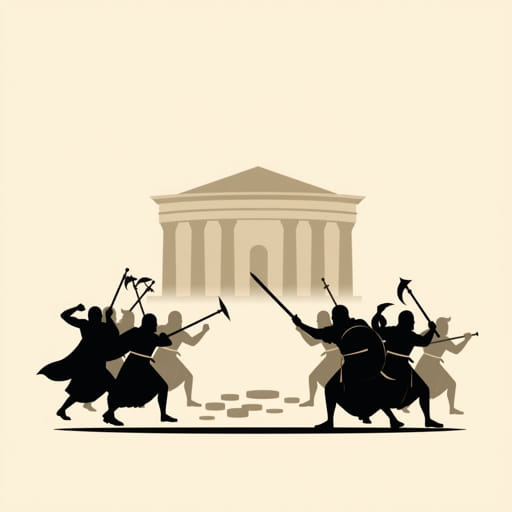
In the early fifth century, the Roman Empire faced a crisis unlike any it had encountered before. The once-mighty city of Rome, center of the ancient world, found itself under siege from a foreign force. In 410 AD, the Visigoths, led by their ambitious king Alaric, entered the Eternal City in a dramatic act that shocked the empire and signaled the decline of Roman dominance. The sack of Rome by the Visigoths was not just a military conquest it was a symbolic rupture in the myth of Roman invincibility and a defining moment in the fall of the Western Roman Empire.
The Rise of the Visigoths
The Visigoths were originally part of the Gothic people, a Germanic tribe that had migrated southward from Scandinavia and Eastern Europe. By the third and fourth centuries, pressure from the Huns and a desire for better lands led many Goths to seek refuge within the borders of the Roman Empire. Initially, they were accepted as allies, but mistreatment and exploitation soon turned them into adversaries.
In 376 AD, a large group of Visigoths under King Fritigern crossed the Danube River into Roman territory. Although they were allowed in as refugees, they were exploited by corrupt Roman officials. This mistreatment led to rebellion, culminating in the catastrophic Battle of Adrianople in 378 AD, where the Roman Emperor Valens was killed and the Eastern Roman army suffered a devastating defeat. This marked the beginning of a long and uneasy relationship between Rome and the Visigoths.
Alaric and His Leadership
Alaric, a nobleman of the Balti dynasty, emerged as a skilled leader of the Visigoths around the year 395. Frustrated by the lack of recognition and compensation for his service in the Roman military, he led a series of raids and campaigns across the Balkans and into Italy. Alaric’s demands were not merely for plunder; he sought land and a formal position within the Roman political structure for his people.
Rome, however, was plagued by internal strife, with civil wars, weak leadership, and constant power struggles among generals and emperors. Alaric exploited these weaknesses, advancing into Italy and threatening Rome multiple times before finally besieging the city in 408 AD. After two years of negotiations, standoffs, and failed compromises, Alaric lost patience.
The Sack of Rome in 410 AD
On August 24, 410 AD, the Visigoths entered Rome through the Salarian Gate, allegedly opened by slaves within the city. For three days, the Visigoths looted, burned, and plundered the once-great city. Churches were spared from the worst of the violence, but homes, temples, and public buildings suffered heavily. The sack of Rome by the Visigoths was the first time in 800 years that the city had fallen to a foreign enemy, and the psychological impact was immense.
This sack was not a random act of destruction. Alaric maintained a level of discipline among his troops, avoiding total annihilation and unnecessary slaughter. Nevertheless, the event marked a turning point in European history. Rome was no longer the untouchable heart of a vast empire it had become vulnerable, its prestige irreparably damaged.
Reactions Across the Empire
The news of Rome’s fall sent shockwaves throughout the Roman world. Saint Jerome, a Christian scholar living in Bethlehem at the time, wrote that the entire world collapsed into ruin. The Roman Senate, still existing in name, was powerless to stop the collapse, and citizens fled the city in fear and confusion. Pagans blamed the Christians for abandoning the old gods, while Christians saw it as a test of faith.
Augustine of Hippo responded with his influential workThe City of God, arguing that Rome was an earthly city destined to fall, unlike the eternal city of God. His writings helped shape Christian thought for centuries and provided spiritual context to the physical destruction of the imperial city.
Aftermath and the Fate of the Visigoths
Following the sack of Rome, the Visigoths did not remain in the city. They moved southward through Italy, hoping to cross into Africa where they believed they could find more stable territory. However, Alaric died unexpectedly later in 410 AD, and his followers buried him in a riverbed, hiding his final resting place.
Alaric’s successor, Ataulf, eventually led the Visigoths into southern Gaul (modern-day France) and then into Hispania (modern-day Spain). There, they established the Visigothic Kingdom, which would last for over two centuries before falling to the Moors in 711 AD.
Legacy of the Sack
The sack of Rome by the Visigoths in 410 AD did not end the Roman Empire, but it signaled the beginning of the end. The Western Roman Empire would limp on for several more decades, finally collapsing in 476 AD when the Germanic chieftain Odoacer deposed the last emperor, Romulus Augustulus. However, the Eastern Roman Empire, or Byzantine Empire, would continue for nearly another thousand years.
More importantly, the sack shattered the illusion of Rome’s invincibility. It demonstrated that Rome could be penetrated and humbled by forces it once considered barbaric. For the Visigoths, the sack was a turning point from being a wandering, marginalized group to a recognized political power. For the people of Europe, it marked a transition into what would later be called the Middle Ages.
Key Takeaways About the Visigothic Sack
- The Visigoths were a Germanic tribe that transitioned from enemies to reluctant allies of Rome.
- Alaric, their leader, sought recognition, land, and peace not mere destruction.
- The sack of Rome in 410 AD was short but symbolically massive in historical significance.
- The event deeply shook Roman identity and became a milestone in the empire’s gradual fall.
- The Visigoths eventually established a kingdom in Hispania, becoming part of Europe’s new post-Roman order.
The sack of Rome by the Visigoths is one of history’s most poignant symbols of change. It encapsulates the fall of an old world and the birth of a new, uncertain era. While the physical destruction was limited compared to modern standards, the emotional and cultural impact was profound. Rome’s fall in 410 AD remains a cautionary tale of imperial overreach, internal weakness, and the power of determined outsiders to reshape history.