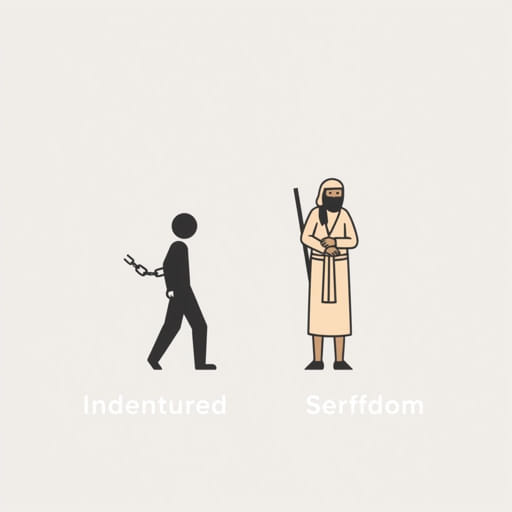
Throughout history, systems of labor have taken various forms depending on economic needs, social structures, and legal frameworks. Two notable systems indentured servitude and serfdom have been particularly influential in shaping societies in different parts of the world. While both involved restricted freedoms and obligations to a master or lord, they emerged from distinct contexts and carried different social, legal, and economic implications. Understanding the differences between indentured servitude and serfdom offers deeper insight into the complexities of labor, power dynamics, and class struggles throughout history.
Origins and Historical Context
Indentured Servitude
Indentured servitude was primarily a labor system used from the 17th to the 19th centuries in the Americas and Europe. It emerged as a means to populate and cultivate colonies, particularly in North America. Under this system, individuals agreed to work for a certain number of years typically between four and seven in exchange for passage to the New World, shelter, and food. Many indentured servants were poor Europeans seeking a new life, and this arrangement offered a temporary solution to their lack of resources.
Serfdom
Serfdom, on the other hand, dates back to the early Middle Ages and was widespread across feudal Europe, especially in Eastern regions like Russia. Serfs were peasants legally tied to the land owned by a feudal lord. Unlike indentured servants, serfs had no contract or fixed term of labor. They were born into their status and could not legally leave the land without permission. Their existence was bound by tradition, law, and the rigid structure of feudal society.
Legal Status and Freedom
Contracts and Duration
A key difference between indentured servitude and serfdom lies in the legal status of the laborer. Indentured servants voluntarily signed contracts, even if often under economic duress. These agreements had defined durations and clear expectations. Upon completion, many servants were granted ‘freedom dues,’ which might include land, money, or tools to start an independent life.
Serfs, however, had no legal agreement that outlined an endpoint. Their status was hereditary and lifelong unless manumitted by the lord. They could not marry, relocate, or engage in trade without permission. In essence, serfdom was a more permanent and rigid condition.
Economic Conditions and Compensation
Living Conditions
While both systems often involved poor living conditions, indentured servants typically lived in closer proximity to their masters and could experience variable treatment depending on the master’s disposition. Some were treated well and gained valuable skills, while others faced harsh punishment and neglect.
Serfs, though tied to the land, had a degree of subsistence stability. They were allowed to cultivate small plots for their own use in exchange for laboring on the lord’s land. However, they had to pay heavy dues in produce, labor, or money, which made upward mobility nearly impossible.
Opportunity for Advancement
Indentured servants, after serving their term, could potentially acquire land, start businesses, and rise socially, especially in colonies where land was more available. This opportunity, albeit limited, distinguished indentured servitude as a temporary condition rather than a lifelong burden.
Serfs had little chance of escaping their station. Though some could buy their freedom or be granted emancipation, these cases were rare. Their social and economic roles were rigidly defined, and legal mechanisms ensured they remained at the bottom of the hierarchy.
Geographic and Cultural Context
Where Each System Was Common
- Indentured Servitude: Common in colonial North America, particularly in British, Dutch, and French colonies.
- Serfdom: Predominantly found in medieval and early modern Europe, especially in France, Germany, and Russia.
Cultural Attitudes
Indentured servitude was often seen as a contract of economic necessity. While harsh, it was viewed as a stepping-stone to freedom and prosperity. In contrast, serfdom was entrenched in feudal ideology. Lords believed they had a paternalistic role over their serfs, while serfs were expected to exhibit loyalty and obedience in a system resembling inherited obligation more than voluntary work.
Transition and Decline
End of Indentured Servitude
Indentured servitude began to decline in the 18th century, particularly with the rise of African slavery in the Americas. As plantation economies grew, enslaved labor became more profitable and permanent, leading to a decrease in the demand for indentured workers. Laws also evolved, making it harder for servants to sue for mistreatment or breach of contract, further discouraging participation in the system.
Abolition of Serfdom
Serfdom persisted much longer in Eastern Europe. In Russia, it was abolished by Tsar Alexander II in 1861, much later than in Western Europe. The end of serfdom came about due to a mix of social unrest, economic inefficiency, and international pressure for modernization. Although technically free, former serfs often remained in poverty due to restrictive land policies and lack of support.
Comparison Summary
Understanding indentured servitude vs serfdom requires examining their legal, social, and economic frameworks. Despite some superficial similarities labor in exchange for basic needs they were fundamentally different in intent, structure, and outcomes.
- Voluntariness: Indentured servitude was contractual and, in theory, entered willingly. Serfdom was hereditary and involuntary.
- Duration: Indentured servitude had a limited term; serfdom was lifelong and generational.
- Legal Rights: Indentured servants had some legal protections and could eventually become free citizens. Serfs had few rights and remained under the lord’s control indefinitely.
- Social Mobility: Indentured servants had the potential for advancement. Serfs were locked into their class status.
Lasting Legacy
Both indentured servitude and serfdom left deep imprints on the societies in which they operated. Indentured servitude shaped early migration patterns and class structures in colonial societies. It also laid a foundation for labor exploitation that evolved into institutional slavery. Serfdom, meanwhile, reinforced the feudal order in Europe, delaying modernization and economic development in regions where it persisted.
These systems are reminders of how labor can be manipulated under different guises contractual or hereditary when power is concentrated in the hands of a few. In modern times, their legacies continue to inform discussions on human rights, labor laws, and historical justice. While both have been abolished, their echoes still influence social and economic inequalities today.