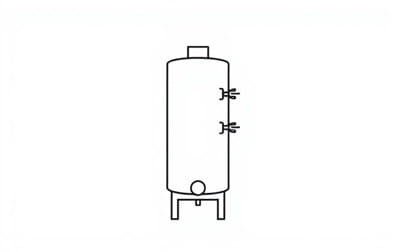
How to Design a Reboiler A Practical Guide for Engineers and StudentsReboilers are essential components in chemical processing, particularly in distillation columns. Their primary role is to provide the necessary heat to vaporize a liquid mixture, allowing for the separation of components based on boiling points. Designing a reboiler involves understanding heat transfer, fluid flow, and equipment constraints. Whether you’re a student, process engineer, or technician, learning how to design a reboiler is crucial for efficient plant operations.
This guide explains how to design a reboiler step by step, using simple language and practical examples.
What Is a Reboiler?
A reboiler is a type of heat exchanger used at the bottom of a distillation column. It heats the bottom product, generating vapor that rises through the column to assist with component separation.
There are several types of reboilers
-
Kettle-type reboiler
-
Thermosiphon reboiler
-
Forced circulation reboiler
-
Fired reboiler
The selection depends on the process, fluid properties, available utilities, and layout constraints.
Why Reboiler Design Is Important
A poorly designed reboiler can lead to
-
Inefficient separation
-
Increased energy consumption
-
Equipment damage due to fouling or overheating
-
Operational instability in the distillation column
Proper design ensures optimal thermal performance, energy efficiency, and safety.
Step 1 Understand the Process Requirements
Before starting any calculation, gather the necessary process data
-
Feed composition
-
Boiling point range
-
Operating pressure
-
Required vapor flow rate
-
Heat duty (Q)
-
Type of fluid and its physical properties
Knowing this information allows for accurate sizing and selection of the reboiler type.
Step 2 Choose the Right Reboiler Type
Each type has its own application
-
Kettle Reboiler Simple and robust. Suitable for dirty fluids or large heat duties.
-
Thermosiphon Reboiler Common in industry. Relies on natural circulation.
-
Forced Circulation Reboiler Uses a pump to circulate liquid. Good for viscous or fouling fluids.
-
Fired Reboiler Direct-fired with a burner. Used in high-temperature applications like oil refining.
The choice depends on space, cost, and process conditions.
Step 3 Calculate Heat Duty (Q)
Heat duty is the amount of heat energy required to vaporize the liquid.
Formula Q = m × λ
Where
-
Q = Heat duty (kW or BTU/hr)
-
m = Mass flow rate of vapor (kg/s)
-
λ = Latent heat of vaporization (kJ/kg)
If the fluid also requires heating before vaporization, include sensible heat
Q = m × Cp × ΔT + m × λ
Where Cp is the specific heat and ΔT is the temperature rise before boiling.
Step 4 Estimate the Overall Heat Transfer Coefficient (U)
The heat transfer coefficient depends on the fluid phase, flow regime, and fouling tendencies.
Typical values for U (in W/m²·K)
-
Condensing steam 1000-5000
-
Boiling liquids 500-1500
-
Oil-based fluids 100-800
Use past plant data or literature for estimation if lab data is unavailable.
Step 5 Calculate Required Heat Transfer Area (A)
Formula A = Q / (U × ΔTlm)
Where
-
A = Heat transfer area (m²)
-
Q = Heat duty (W)
-
U = Overall heat transfer coefficient (W/m²·K)
-
ΔTlm = Log mean temperature difference (K)
ΔTlm is calculated using
ΔTlm = (ΔT1 – ΔT2) / ln(ΔT1 / ΔT2)
Where ΔT1 and ΔT2 are temperature differences at each end of the exchanger.
Step 6 Select Heat Exchanger Design Parameters
This step involves specifying
-
Tube diameter and length
-
Number of tubes
-
Shell diameter (for shell-and-tube)
-
Tube pitch
-
Baffle spacing
-
Material of construction
These parameters are typically chosen based on process needs and industry standards.
For example, a kettle reboiler might use a shell-and-tube exchanger with large diameter tubes to reduce fouling and ensure smooth boiling.
Step 7 Check Pressure Drop
High-pressure drop can hinder liquid circulation and affect column stability.
-
For thermosiphon reboilers, keep pressure drop below 0.1 bar.
-
For forced circulation, the pump must handle the full pressure drop.
Use fluid flow equations or software to estimate the pressure drop across the exchanger.
Step 8 Ensure Safe Operation and Maintenance Access
Design the reboiler layout so that it is easy to access for inspection, cleaning, and tube replacement. Include
-
Drain and vent nozzles
-
Proper supports
-
Insulation
-
Safety valves (especially for fired reboilers)
Also consider startup and shutdown sequences, especially for high-boiling-point fluids.
Step 9 Validate with Simulation Tools
Use process simulation software like Aspen HYSYS or CHEMCAD to
-
Cross-check manual calculations
-
Visualize vapor-liquid equilibrium
-
Test various operating scenarios
Simulation helps refine the design before fabrication.
Step 10 Final Documentation
After completing the design, prepare the following documents
-
Design summary and calculation sheet
-
Equipment specification sheet
-
Piping and instrumentation diagram (P&ID)
-
General arrangement drawing
-
Materials of construction list
These documents are critical for procurement, fabrication, and plant integration.
Common Design Mistakes to Avoid
-
Underestimating fouling factor
-
Using incorrect fluid properties
-
Ignoring thermal expansion in tubes
-
Oversizing the area without checking fluid velocity
-
Not accounting for startup conditions
Being thorough at every step can prevent operational and safety issues down the line.
Applications of Reboilers
Reboilers are widely used in
-
Oil refineries
-
Petrochemical plants
-
Pharmaceutical industries
-
Food processing units
-
Waste treatment plants
Each application may have different temperature and material requirements.
Designing a reboiler is a systematic process that balances thermal performance, cost, and safety. By understanding the type of reboiler needed, calculating heat duty, selecting appropriate materials, and ensuring safe operation, engineers can develop efficient and reliable equipment.
Whether you are designing for a large refinery or a small batch distillation unit, following these steps ensures that the reboiler meets process demands and remains easy to maintain over time.