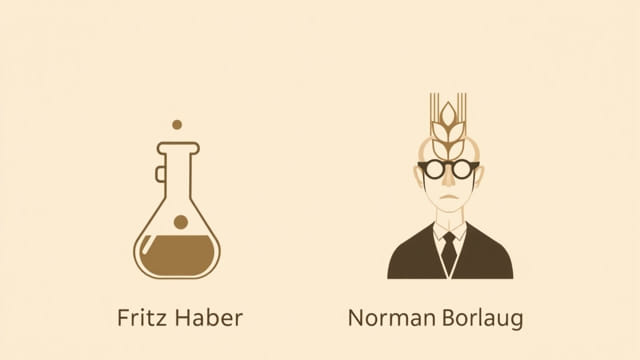
Throughout the 20th century, few scientists have left as profound an impact on the world as Fritz Haber and Norman Borlaug. Though they lived in different times and worked in different contexts, both contributed significantly to the development of modern agriculture and the fight against hunger. Their legacies are both celebrated and controversial, as they intersect with complex historical, scientific, and ethical debates. Understanding their contributions is essential to grasp the development of agricultural science and the broader history of human efforts to feed a growing global population.
Fritz Haber: The Chemist Who Fed and Fought
The Birth of Synthetic Fertilizer
Fritz Haber, a German chemist born in 1868, is best known for his invention of the Haber-Bosch process, which allowed the large-scale synthesis of ammonia from nitrogen and hydrogen gases. This scientific breakthrough made it possible to produce synthetic fertilizers in massive quantities, which revolutionized agriculture by increasing crop yields. Before this development, natural sources like guano and nitrates were the primary means of enriching soil, limiting the scale of food production.
A Dual Legacy
While Haber’s work earned him the 1918 Nobel Prize in Chemistry, his legacy is not without controversy. During World War I, he applied his chemical expertise to warfare, developing deadly chlorine gas used in trench battles. This earned him the label of a scientist of dual use, someone whose innovations both nurtured life and contributed to mass death. Despite these contradictions, the Haber-Bosch process is still regarded as one of the most important inventions in human history due to its role in feeding billions.
Global Agricultural Impact
The application of synthetic fertilizers, thanks to Haber’s work, enabled many nations to shift from subsistence farming to high-yield agriculture. This became especially important in the 20th century when food security was an increasing concern due to rapid population growth. Today, nearly half of the global population depends on food grown using synthetic fertilizers derived from the Haber-Bosch process. Without it, modern agriculture as we know it would not exist.
Norman Borlaug: The Father of the Green Revolution
Background and Early Work
Norman Borlaug was born in 1914 in Iowa, United States. He earned a Ph.D. in plant pathology and began his career working on wheat diseases in Mexico. His efforts to develop high-yield, disease-resistant varieties of wheat were instrumental in transforming agricultural production in the mid-20th century. His work is often credited with sparking the Green Revolution a period of agricultural transformation that significantly reduced famine and hunger in developing countries.
The Green Revolution
Borlaug’s innovations included breeding wheat varieties that responded well to fertilizer inputs and were resistant to stem rust, a common fungal disease. He also emphasized the use of irrigation and synthetic fertilizers, creating a system where farmers could reliably produce surplus crops. Countries like India and Pakistan, once on the brink of widespread famine, saw dramatic increases in food production due to these methods. This period is often viewed as a turning point in global food security.
A Humanitarian Legacy
For his role in saving an estimated one billion lives from starvation, Borlaug received the Nobel Peace Prize in 1970. He believed that applying science to agriculture was the most effective way to address global hunger and promote peace. His advocacy for continued agricultural innovation, including the use of genetically modified organisms (GMOs), demonstrated his lifelong commitment to feeding the world’s growing population.
Comparing Two Agricultural Pioneers
Similar Goals, Different Methods
Both Fritz Haber and Norman Borlaug were driven by a desire to solve humanity’s most pressing problem: how to produce enough food. Haber approached the issue from a chemical standpoint, seeking to manipulate nitrogen to produce fertilizer. Borlaug, on the other hand, used plant breeding and agricultural techniques to improve crop performance. Together, their contributions form the backbone of modern high-yield agriculture.
- Haber enabled fertilizer production through chemistry.
- Borlaug used improved seeds and modern techniques to increase yields.
- Both emphasized the importance of science in addressing hunger.
- Their legacies intersect in the widespread use of synthetic fertilizers in Borlaug’s Green Revolution.
Ethical and Environmental Questions
While both scientists contributed to reducing hunger, their work has raised important ethical and environmental issues. In Haber’s case, his involvement in chemical warfare continues to provoke criticism. Borlaug’s Green Revolution, although successful, has been linked to environmental degradation, including soil depletion and excessive use of water and chemicals. These concerns have led to calls for more sustainable approaches to agriculture.
Long-Term Impact on Global Food Systems
Feeding the Future
The innovations of Fritz Haber and Norman Borlaug laid the groundwork for a world that can support over eight billion people. Modern agriculture continues to evolve based on their ideas, combining chemistry, biology, and technology to improve food production. Their work also inspired generations of scientists and policymakers to prioritize food security on a global scale.
Lessons for Today
Today’s challenges climate change, soil erosion, and water scarcity require new strategies that build upon the foundations laid by Haber and Borlaug. Understanding their contributions helps us appreciate the complexities of agricultural development and the importance of balancing innovation with sustainability. As we move into the future, the key will be to merge their scientific breakthroughs with environmentally conscious farming practices.
Two Men, One Mission
Fritz Haber and Norman Borlaug may have worked in different eras and employed different tools, but they shared a common goal: to ensure that humanity had enough food. Through chemistry and agricultural science, they reshaped the world and altered the trajectory of human civilization. Their work continues to feed billions, and their legacies serve as both a testament to the power of science and a reminder of the responsibilities it entails. In studying their lives and contributions, we gain not only historical insight but also guidance for addressing the pressing food security issues of today and tomorrow.