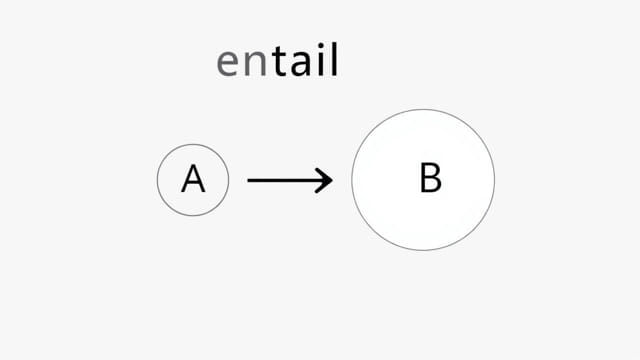
Entailment is a fundamental concept in logic, linguistics, and philosophy that describes a specific relationship between statements or propositions. Understanding entailment helps clarify how one statement logically follows from another, and this relationship is critical for reasoning, argumentation, and language comprehension. In everyday communication, entailment helps us make sense of implications and assumptions, while in formal logic, it serves as the backbone for proofs and deductions. This topic will explore the definition of entailment, provide clear examples, and explain its importance in various fields.
What Is Entailment?
Entailment refers to a logical relationship between two statements where the truth of one statement guarantees the truth of the other. If statement A entails statement B, then whenever A is true, B must also be true. However, the reverse is not necessarily the case B being true does not automatically mean A is true. Entailment expresses a necessary connection between premises and conclusions in reasoning.
Formal Definition
In formal logic, entailment is often denoted as A ⊨ B, meaning A entails B. This means in every model or interpretation where A is true, B is also true. Entailment is stricter than mere correlation or implication; it requires that B cannot be false if A is true.
Types of Entailment
- Logical Entailment: This involves strict logical necessity, where the truth of one statement follows inevitably from another.
- Semantic Entailment: Common in linguistics, where meaning relations ensure one sentence logically follows from another based on language understanding.
- Pragmatic Entailment: Related to context and speaker intention, where the meaning implies another statement based on how it is used in conversation.
Examples of Entailment
Example 1: Simple Logical Entailment
Consider these two statements:
- A: All birds have wings.
- B: A sparrow has wings.
If statement A is true, then statement B must also be true because a sparrow is a type of bird. Here, A entails B. However, B being true does not mean A is true because just knowing a sparrow has wings does not confirm that all birds have wings.
Example 2: Linguistic Entailment
Look at these sentences:
- A: She is pregnant.
- B: She is a woman.
The truth of A entails B because only women can be pregnant biologically. Hence, if A is true, B must be true. This is semantic entailment based on the meanings of the words involved.
Example 3: Non-Entailment
Not all statements imply entailment. For example:
- A: John owns a car.
- B: John owns a vehicle.
Here, A might entail B because a car is a vehicle. But consider:
- A: John owns a car.
- B: John owns a motorcycle.
In this case, A does not entail B because owning a car does not guarantee owning a motorcycle. So, entailment is not just about relatedness; it is about necessity.
Why Is Entailment Important?
Entailment plays a crucial role in multiple areas, including:
Logic and Mathematics
In formal reasoning, entailment allows us to derive conclusions that must be true if our premises are true. This helps in constructing valid arguments and proofs.
Linguistics and Language Processing
Understanding entailment is essential for natural language understanding, machine translation, and semantic analysis. It helps computers and humans determine if one sentence logically follows from another.
Philosophy and Critical Thinking
Philosophers use entailment to analyze arguments, identify fallacies, and explore the nature of truth and meaning.
How to Identify Entailment in Sentences
- Check for Necessity: If the truth of one statement guarantees the truth of another, entailment likely exists.
- Use Substitution: Substitute terms or ideas to see if the logical relationship holds.
- Analyze Context: Some entailments depend on cultural or contextual knowledge.
Common Confusions with Entailment
Entailment is sometimes confused with implication or inference, but there are important differences:
Implication vs. Entailment
Implication is often used more loosely and can be probabilistic or suggestive. Entailment is stricter and requires logical necessity.
Inference vs. Entailment
Inference is the process of deriving a conclusion from premises. Entailment is the relationship that justifies an inference. Inference is human reasoning; entailment is the logical connection.
Entailment is a precise and important concept that connects statements in a necessary logical relationship. Knowing whether one statement entails another is essential for clear thinking, effective communication, and many fields like logic, linguistics, and philosophy. By examining examples, understanding the conditions for entailment, and distinguishing it from related concepts, anyone can improve their ability to analyze arguments and interpret meaning accurately.