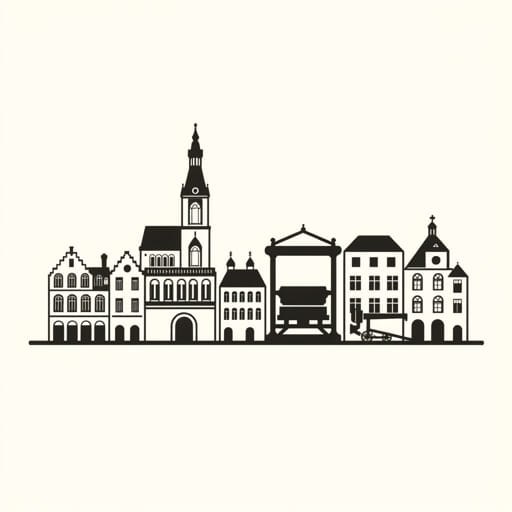
In the early days of mass communication, the publication of newspapers marked a transformative step in the spread of information, public discourse, and political awareness. The invention of the printing press in the 15th century set the stage for this development, but it was not until the early 17th century that the first newspaper appeared in a recognizable form. One city stands out as the birthplace of this important innovation Strasbourg. Situated in what was then the Holy Roman Empire, Strasbourg played a crucial role in the birth of modern journalism, and its contribution to the world of print media continues to be remembered in the context of communication history.
The Emergence of Newspapers in Strasbourg
The Context of the Holy Roman Empire
Strasbourg, a city with a rich cultural and political history, was part of the Holy Roman Empire during the early 1600s. The region was known for its vibrant trade, religious diversity, and intellectual life. It was during this period that the world witnessed the emergence of the first regularly published newspaper, theRelation aller Fürnemmen und gedenckwürdigen Historien, often translated as ‘Account of all distinguished and commemorable news.’
Johann Carolus: The Pioneer
Johann Carolus, a printer and bookseller based in Strasbourg, is widely credited with publishing the first newspaper in 1605. Before this innovation, printed news existed in the form of newsletters or pamphlets, which were often irregular and event-specific. Carolus transformed this system by compiling weekly news reports from various sources and presenting them in a consistent format. This regularity marked the birth of the modern newspaper.
Why Strasbourg Became a Media Hub
Strategic Location
Strasbourg’s location at the crossroads of Europe made it a key center for trade and communication. Positioned along the Rhine River, it connected different parts of the continent and received a constant flow of travelers, merchants, and diplomats. This access to varied sources of information allowed Carolus to gather news from across Europe and consolidate it into his publication.
Printing Tradition and Intellectual Climate
By the early 17th century, Strasbourg had already established itself as a printing center. With a number of active presses and a strong tradition of scholarly work, the city offered the perfect environment for the development of a new kind of media. The Protestant Reformation had also left its mark on the city, encouraging literacy and the spread of ideas through printed texts. These factors combined to create an atmosphere that welcomed innovation in the field of journalism.
The Role of the First Newspaper
Content and Format
TheRelationcontained news about politics, wars, trade, and diplomatic events. The stories were often gathered from letters, eyewitness accounts, and reports sent by correspondents in other cities. Although the language was formal and the tone objective, the publication was revolutionary in its consistency and accessibility.
Audience and Impact
The newspaper was initially targeted at wealthy merchants, political officials, and scholars. These individuals needed up-to-date information to make business or policy decisions. Over time, as literacy rates improved and printing became more affordable, newspapers became more accessible to a broader segment of the population. The publication of news in this format gradually encouraged the public to engage in debates and form opinions, laying the groundwork for civic participation and the public sphere.
Legacy of Strasbourg’s Contribution
Spreading the Newspaper Model
After the success of Carolus’s newspaper, other cities across Europe began to adopt similar models. Cities like Amsterdam, London, and Paris soon saw the birth of their own newspapers, inspired by the Strasbourg example. These early publications became vital tools for governments, merchants, and citizens alike.
Influence on Modern Journalism
Strasbourg’s role in the creation of the first newspaper continues to influence journalism today. The practice of publishing regular, fact-based news became a standard, and the role of the press as a watchdog and informant for the public was gradually solidified. While technology and formats have evolved, the basic idea of providing timely, relevant information to the masses can be traced back to the innovations made in this historic European city.
Strasbourg Today
A Center of European Dialogue
Strasbourg remains a city of historical importance, now home to major European institutions such as the European Parliament and the Council of Europe. It symbolizes unity, communication, and cooperation values that echo its legacy as the birthplace of the newspaper.
Preserving Media History
Efforts have been made to preserve Strasbourg’s contribution to media history. Archives, museums, and academic institutions continue to highlight the city’s role in shaping modern communication. The story of Johann Carolus and his pioneering work serves as an example of how innovation can arise in times of change and contribute to shaping society for centuries.
The first newspaper published in Strasbourg marked a turning point in the way societies shared and consumed information. It set in motion a new era of communication, one that emphasized regularity, factual reporting, and public engagement. Johann Carolus, working in a city shaped by trade, religion, and scholarship, introduced a concept that would spread across continents and evolve into one of the most powerful tools of the modern world. Strasbourg’s legacy as the city where the first newspaper was published remains an enduring chapter in the global history of journalism, influencing how people access information and engage with the world around them.