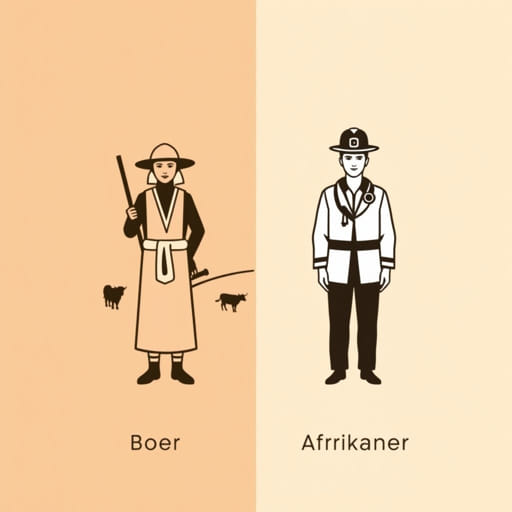
The terms ‘Boer’ and ‘Afrikaner’ are often used interchangeably, but they have distinct historical and cultural meanings. Both refer to groups of white South Africans primarily descended from Dutch settlers, but their origins, experiences, and identities evolved differently over time. Understanding the difference between a Boer and an Afrikaner requires exploring South African colonial history, language development, and the socio-political roles each group played throughout the centuries. This distinction is important for anyone studying South African identity, culture, and history, especially in the context of colonization, the Anglo-Boer Wars, and apartheid.
Historical Background of the Boers
Who Were the Boers?
The Boers were primarily Dutch-speaking farmers who settled in the Cape Colony during the 17th and 18th centuries. The word ‘Boer’ literally means ‘farmer’ in Dutch. These settlers were largely of Dutch, German, and French Huguenot descent. Over time, they developed a distinct identity tied to the rural farming lifestyle and frontier hardships.
By the late 18th century, the Boers became disillusioned with British rule, which took control of the Cape Colony from the Dutch in 1806. In response, many Boers moved inland during the Great Trek, a large-scale migration during the 1830s and 1840s. These trekkers established independent republics such as the Orange Free State and the South African Republic (Transvaal).
The Boer Wars
Two major conflicts, known as the First and Second Anglo-Boer Wars, defined Boer resistance against British imperialism. The First Boer War (1880-1881) was a brief conflict where the Boers successfully defended their independence. However, the Second Boer War (1899-1902) was much more brutal and ended with British victory. Thousands of Boers died in concentration camps, and their republics were absorbed into the British Empire.
This period of resistance and loss significantly shaped Boer identity. The trauma of war and the struggle for autonomy contributed to a hardened national consciousness among the Boers, often characterized by strong rural values, Calvinist religion, and a distrust of British authority.
Understanding the Afrikaners
Emergence of the Afrikaner Identity
The term ‘Afrikaner’ refers to a broader group that includes the Boers but is not limited to them. While Boers were mostly rural farmers, Afrikaners as a cultural group emerged in the 19th and 20th centuries and included urban professionals, politicians, and intellectuals. Afrikaners are united by the Afrikaans language, which evolved from Dutch but developed uniquely in South Africa.
Afrikaner nationalism grew in the early 20th century and became a powerful political force by mid-century. The National Party, dominated by Afrikaners, implemented apartheid policies after coming to power in 1948. This political development further expanded the definition of who was considered Afrikaner, including many who had never lived on farms or identified with the original Boer lifestyle.
Language and Culture
Afrikaans became a symbol of Afrikaner identity. Although it originated from Dutch, Afrikaans incorporated words from indigenous African languages, Malay, and Portuguese. It became the mother tongue for millions of white South Africans and was eventually recognized as one of South Africa’s official languages.
While Boers typically maintained conservative values rooted in Calvinist religion and agrarian life, Afrikaners in general represent a wider cultural spectrum, including urbanization, education, and broader political involvement. Today, most Afrikaners are descendants of both Boers and other Dutch-speaking settlers who assimilated into the Afrikaner identity over generations.
Key Differences Between Boer and Afrikaner
Social and Geographic Identity
The Boer identity is historically rural and frontier-based, rooted in a pastoral lifestyle. Boers often lived in isolated homesteads or farms, maintaining strong family ties and religious traditions. In contrast, Afrikaners as a group expanded into cities, government, and professional roles. They helped shape South Africa’s political and cultural infrastructure, especially during the 20th century.
Political Roles
Boers were originally anti-British and strove for independence through the formation of their republics. Afrikaners later came to dominate South African politics through the National Party and enforced the apartheid system. While Boers formed the cultural and historical roots of the Afrikaners, not all Afrikaners were Boers or shared the same political aspirations in earlier periods.
Language and Evolution
Although both Boers and Afrikaners spoke a form of Dutch that eventually became Afrikaans, the Afrikaner identity is more linguistically inclusive. Afrikaans speakers today include not only white Afrikaners but also colored communities and others. The Boer identity, in contrast, was more ethnically and culturally exclusive, rooted in a pioneering farmer image.
Modern Interpretations and Legacy
Boer Identity Today
In modern South Africa, the term ‘Boer’ is sometimes still used, but it generally refers to a historical or cultural lineage rather than a distinct ethnic group. Some white South Africans continue to identify as Boers to emphasize their rural heritage, farming lifestyle, or connection to the old Boer republics.
There are also small communities of Boers who live somewhat separately from the rest of South African society, maintaining traditions that reflect 19th-century values and lifestyle. However, this group is a minority and does not represent the majority of Afrikaans-speaking South Africans.
The Afrikaner Identity in the 21st Century
Today, Afrikaners are an integral part of South African society. Though the legacy of apartheid continues to cast a long shadow, many Afrikaners have embraced democratic principles and work toward reconciliation. The modern Afrikaner identity includes a wide range of political beliefs, professions, and lifestyles.
In the post-apartheid era, Afrikaner culture is adapting to a multicultural society. While Afrikaans remains one of the official languages, its political dominance has declined. However, Afrikaner contributions to literature, education, and agriculture continue to be significant.
In summary, while all Boers can be considered Afrikaners, not all Afrikaners are Boers. The Boers represent a specific subset of Afrikaners with a distinct rural, historical, and military background rooted in the colonial frontier and the Boer Wars. Afrikaners, on the other hand, encompass a broader, more inclusive identity tied together by language and culture rather than a single lifestyle or historical event. Understanding the difference between a Boer and an Afrikaner provides deeper insight into South Africa’s complex cultural landscape and the historical forces that shaped the nation.