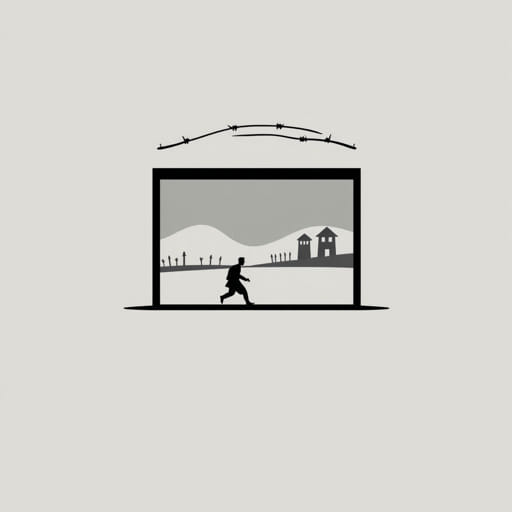
One of the most extraordinary stories of courage and resistance during World War II is that of Witold Pilecki, a Polish resistance fighter who voluntarily entered the infamous Auschwitz concentration camp to gather intelligence and organize resistance from within. His decision to infiltrate the camp was both daring and incredibly dangerous, but it offered the world its first detailed reports of the horrors occurring there. Eventually, after nearly three years inside, Pilecki executed a remarkable escape from Auschwitz. His mission and escape remain among the most heroic undertakings of the war.
Witold Pilecki: The Man Behind the Mission
Background and Motivation
Witold Pilecki was born in 1901 in the Russian Empire, in what is now Belarus. A dedicated soldier and patriot, he fought in the PolishSoviet War and later became an officer in the Polish Army. When Nazi Germany invaded Poland in 1939, Pilecki joined the Polish underground resistance, the Home Army (Armia Krajowa).
In 1940, rumors and fragmentary intelligence indicated that the Nazis were carrying out atrocities in a newly established camp Auschwitz. To obtain firsthand information and organize internal resistance, Pilecki volunteered for what seemed like a suicide mission: to be captured and sent to Auschwitz under a false identity.
Entering Auschwitz Voluntarily
In September 1940, Pilecki allowed himself to be arrested during a German street roundup in Warsaw. Using the alias Tomasz SerafiÅski, he was deported to Auschwitz. Inside, he became prisoner number 4859. His mission began in the most brutal of circumstances, surrounded by death, starvation, and relentless abuse.
Resistance Work Inside Auschwitz
Forming the ZOW
Despite the horrific conditions, Pilecki began to organize an underground movement within the camp known as ZOW (ZwiÄ zek Organizacji Wojskowej, or Union of Military Organization). Its goals were to boost prisoner morale, distribute food and information, document German crimes, and prepare for a future uprising.
Pilecki’s organization built a clandestine network across various parts of the camp. They even managed to build a makeshift radio transmitter to send messages to the Polish resistance outside. These early transmissions provided some of the first credible eyewitness reports to the Allies about mass executions, torture, and medical experiments taking place inside Auschwitz.
Risk and Surveillance
The Gestapo maintained intense surveillance inside the camp. Any sign of organized resistance meant torture and execution. Pilecki had to carefully balance growing the ZOW while avoiding detection. Many of his comrades were captured and killed, but he pressed on, convinced that his intelligence was critical for the Allies and the Polish resistance.
Planning the Escape
Lack of External Support
Over time, Pilecki became frustrated. His reports had reached London and the Polish government-in-exile, but no major rescue mission or bombing of the camp materialized. The scale of Nazi atrocities demanded more than intelligence it demanded action. When no external help came, Pilecki realized he had to escape to tell his story in person.
Preparation for Escape
Pilecki and two other prisoners, Jan Redzej and Edward Ciesielski, carefully planned their escape. They worked at a bakery outside the camp perimeter, a rare privilege that gave them slightly more freedom of movement. They collected civilian clothes and forged documents, waiting for the right moment when security would be lax.
The Escape from Auschwitz
The Night of the Escape
On the night of April 26, 1943, the three men made their move. Under cover of darkness, they overpowered a guard, cut the telephone wires to delay alarms, and slipped through a hole in the fence. Running across the surrounding fields and forests, they evaded German patrols and made their way toward safety.
Aftermath and Debrief
The escape was a success, though the journey to freedom was fraught with danger. After days of travel and hiding, they reached the Polish resistance. Pilecki compiled detailed reports, confirming the existence of gas chambers, mass cremations, forced labor, and executions. His debrief was among the earliest and most comprehensive eyewitness accounts of Auschwitz to reach the West.
Legacy and Recognition
Post-War Tragedy
After escaping, Pilecki continued to fight in the Polish resistance and took part in the 1944 Warsaw Uprising. When the war ended, he opposed the Soviet occupation of Poland. Tragically, in 1947 he was arrested by the communist regime, accused of espionage, and executed in 1948 following a show trial. His bravery was suppressed by the regime for decades.
Rehabilitation and Honor
Only after the fall of communism did Pilecki’s story become widely known. He was posthumously honored by the Polish government and remembered as one of the greatest heroes of World War II. Today, schools, monuments, and books preserve the memory of his courage and sacrifice.
- Witold Pilecki voluntarily entered Auschwitz in 1940.
- He founded the ZOW underground resistance movement inside the camp.
- He escaped Auschwitz in April 1943 with two fellow prisoners.
- His detailed reports provided early evidence of the Holocaust.
- Executed in 1948 by Poland’s post-war communist regime.
The story of how Pilecki escaped Auschwitz is not just about a daring flight to freedom it is about moral conviction, self-sacrifice, and the pursuit of truth in the face of unimaginable evil. Witold Pilecki risked everything to expose the horrors of Auschwitz to the world. His escape was not an act of self-preservation but a continuation of his mission. Today, he stands as a symbol of resistance, bravery, and the enduring fight for justice. Remembering how Pilecki escaped from Auschwitz means honoring one of history’s most remarkable acts of courage.